
- What is Y-DNA?
Y-DNA is what we call the sex chromosome “Y” that is passed from a father to his sons only; women do not receive a Y chromosome. Testing the Y chromosome allows for investigation into a male’s paternal family line and can help identify surname lines, living relatives whose Y chromosome is like yours, and ancient migration routes your paternal ancestors may have taken. Genetic females cannot take a Y-DNA test because they do not have a Y chromosome. However, if you are interested in learning about your paternal line’s ancestry, we recommend finding a genetic male to test—like a brother, uncle, father, or cousin.
- Which test should I buy?
If you are looking to begin Y-DNA testing, the Y-37 Marker test allows you to become familiar with Y-DNA results by returning 37 STR values. The Y-111 test, with 111 STR values, is the most beneficial for joining our free Group Projects or for those looking to confirm Y-chromosome matching between two living men. The Big Y-700 is for explorer users, it provides over 400K SNPs and approximately 700 STRs. If you’re looking to find your placement on the Y-DNA Haplotree, then the Big Y-700 is the test you will need to purchase.
Each of the Y-DNA levels we offer will test different amounts of the Y chromosome. The more of the Y chromosome that is tested, the more closely related we can tell if someone is to you.
Out of the three levels that we offer, the Y-37 tests the fewest STRs, and so through analysis of your matches, you can only know you share a common patrilineal ancestor within many hundreds of years for certain.
The Y-111 provides more STR results for a higher-resolution comparison and includes the Y-37 test, so through analysis of your matches you can determine a better timeframe of when your common patrilineal ancestor lived.
The Big Y-700 looks at everything that is genealogically relevant on the Y chromosome, so you’ll receive everything that you would with the Y-37 and the Y-111, plus additional results that allow us to provide more analysis and help you refine even further to determine the best timeframe for when your common patrilineal ancestor lived as well as find your best placement on the world’s largest Y-DNA haplotree. The Big Y-700 is the Gold Standard of male Y-DNA testing.
- What is a Haplogroup?
Every male individual who takes one of our Y-DNA tests will also receive their Y-DNA haplogroup. When humans left Africa tens of thousands of years ago, they departed in small groups that migrated to different parts of the world. Over many generations, each group developed distinct mutations allowing us to identify one from the other. We call these groups of mutations haplogroups, and they can tell us which migratory routes our paternal ancestors traveled.
- What is a Marker or STR?
A marker is what we test in our basic Y-DNA tests. These markers are also referred to as STRs (Short Tandem Repeats) which are a series of repeating nucleotides (A, T, G, C). For example: GACTACTACTACTGG – the STR consists of the three repeated CTA segments. And hence the value of this marker would be “3”. Y-DNA tests look for matching markers or “STRs” between two men, if they match, which would indicate a genetic relationship.
- What does SNP stand for?
Single nucleotide polymorphisms, frequently called SNPs (pronounced “snips”), are the most common type of genetic variations. Each SNP is a mutation or new branch on the tree. The number of SNPs on which people match within a database can be used to tell how closely related they are.
- Will I only match people who share the same surname as me?
Most Y-DNA testers can find a match that shares a common surname with them with some specific exceptions.
If your direct paternal line is from a society or culture that did not adopt surnames until recently or from a society that used patronymic surnames that changed every generation, you may see many surnames on your match list.
England, Scotland, and Ireland tended to adopt surnames in the 1200s and 1300s. Many countries and regions did not officially adopt standard surnames as we think of them today until the 1700s, 1800s, and even the 1900s in some cases.
If your matches share a common ancestor with you before the time when surnames were established in your ancestral location, then you may have multiple different surnames on your match list.
There are various cultural practices that may have existed prior to the standardization of surnames. A last name may have been based on an occupation, patronymics, or on a location where your ancestors lived. A last name may have been taken because your ancestors were part of a specific clan, even though not all men were directly related on the paternal line.
You may also have situations where a different surname than you expected shows up repeatedly in your matches list. This may be because of an undocumented name change or an out-of-wedlock birth somewhere in your direct paternal line.
This rarely means that through the test you discover that you are adopted and that your birth father is not who you thought he was. Most of the time, this is going to be a situation that is much further back in time.
Every now and then, there are no or very few testers in the database who share your direct paternal line. This is either because few people from your ancestral location or line have tested or because there are not many people available to test on your direct line in general.
The Y-DNA test results will typically provide you with fewer matches than an autosomal DNA test. An autosomal DNA like those from Ancestry, MyHeritage, 23andMe and FTDNA’s Family Finder look at all your ancestral lines and is different than the male, Y-DNA tests. The Y-DNA test focuses on just one of those lines, your direct paternal line. If your direct paternal line does not have many descendants, or if it was decimated through an event such as the Holocaust or the Armenian Genocide, then you may have limited matches.
Your match list will typically grow over time. As more people test, more people will match you and be added to your list. We’ll send you a notification when this happens. There are many other historical and cultural reasons why you may not share the same surname with all your Y-DNA matches. Joining surname, geographical, and the appropriate haplogroup Group Projects, as well as reaching out to your matches, can help you uncover your genealogical connections and possibly help break through your brick wall.
- What is a non-paternity event commonly known as an NPE?
A non-paternity event (NPE) is when a person's presumed father is not their biological father. This can be discovered through DNA testing and can be caused by factors such as undisclosed adoption, sperm donation, infidelity, or even hospital mix-ups. The discovery of an NPE can be emotionally complex for those involved, impacting identity and family relationships.
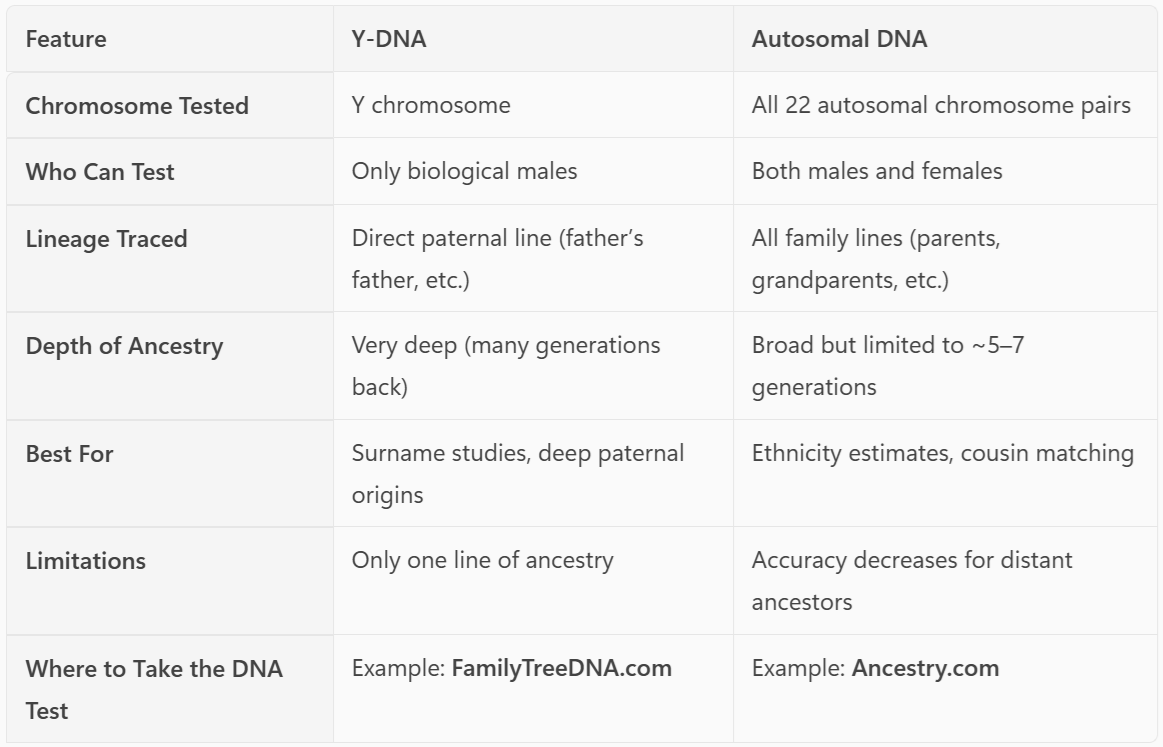
- What is the difference between Y-DNA and autosomal DNA like an Ancestry.com test?
If you have any questions, please contact the Campbell DNA Team at: campbellDNAproject@ccsna.org